
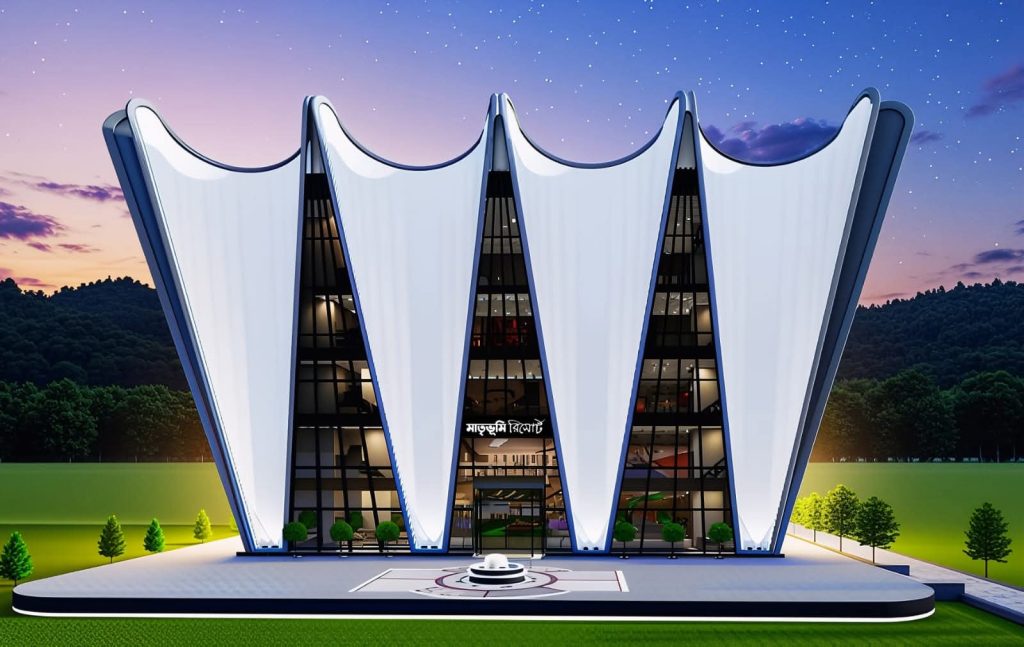
In the world of premium real estate, the most enduring structures are rarely remembered for their square footage or investment yield — they are remembered for how they made people feel. A truly great building is a narrative carved in steel and stone, a conversation between a place, its people, and the passage of time. It is the sensation of stepping through a doorway and immediately understanding that something exceptional is happening here.
At Matribhumi Resort, that is precisely what we are building.
Located just 2.5 km from the Nimtola bus stand along the rapidly developing Dhaka-Mawa Expressway, Matribhumi Resort is designed to be far more than a weekend getaway or a hospitality investment. It is a landmark — an architectural statement that channels the rich natural beauty of the Mawa region into an experience of uncompromising modern luxury. Our guiding philosophy, which we call “The Harmony of Contrasts,” sits at the very heart of every design decision: where the raw, organic beauty of nature meets the sharp, clean sophistication of contemporary architecture.
Here, we pull back the curtain and walk you through the design philosophy, the engineering intelligence, and the aspirational vision that makes Matribhumi Resort one of the most exciting developments in Bangladesh today.
1. Biophilic Design: Nature as the Foundation, Not the Backdrop
For too long, luxury hospitality has treated nature as an amenity — a pleasant view to be observed through a sealed window, a garden visible from a lobby. Matribhumi Resort takes a fundamentally different approach. We believe that the natural world is not a backdrop to great design; it is the foundation of it.
This belief is embodied in our Biophilic Design framework — an architectural methodology that fully integrates natural light, cross-ventilation, living greenery, and water elements into the structural DNA of the resort.
Rather than relying on glass-box sterility, our facades are layered with vertical gardens that function as living insulation, cooling the building naturally, improving air quality, and providing guests with a constantly changing tapestry of green that shifts with the seasons. Flowing water features are built directly into the walls of our common areas, creating both a cooling microclimate and a soothing ambient soundscape that immediately lowers the noise of the modern world.
Floor-to-ceiling panoramic glass expanses are positioned to frame the lush landscape of the Mawa region like living paintings — ensuring that whether a guest is resting in their suite, working from the business lounge, or enjoying a meal, they feel genuinely immersed in the environment rather than isolated from it. In an era of heightened screen fatigue and urban burnout, this reconnection with the earth is not a luxury. It is a necessity. And Matribhumi delivers it.
2. The Aesthetic of Fluidity: Architecture That Moves
Look at the natural world long enough and you will notice that it almost never moves in straight lines. Water flows in curves. Wind bends the tops of trees. The Padma River, which runs as the spiritual and geographic soul of this region, does not rush forward in rigid channels — it sweeps and meanders, carrying life with it in great arcing movements.
This observation became the design DNA of Matribhumi Resort.
Where traditional resort architecture imposes geometric rigidity — rectangular blocks, straight corridors, angular balconies — our structures embrace fluidity. The rooflines curve. The balconies sweep outward in wide, organic arcs inspired directly by the ripple patterns of the river nearby. Each curvilinear terrace is not merely an aesthetic choice; it is an engineering decision that widens sightlines, creates natural wind-capture for ventilation, and gives guests the sensation of being on the prow of a vessel moving through a lush, green landscape.
Inside, we have replaced dark, enclosed corridors with soaring open-air atriums — sun-drenched spaces that rise through multiple floors, allowing natural light to cascade downward and warm air to rise and escape naturally. These atriums serve as the social lungs of the resort, drawing guests into communal gathering without forcing it, and allowing fresh air to circulate throughout the building with minimal mechanical assistance. The result is a structure that breathes — one that feels alive in a way that conventional architecture simply cannot.
3. Five-Star Amenities: Where Engineering Meets Indulgence
Great architecture is not only beautiful — it works. Every space within Matribhumi Resort has been engineered to serve a specific experiential purpose while maintaining the visual and sensory language of the broader design.
The Infinity Horizon Pool is perhaps the resort’s most iconic visual feature. Designed using precision hydraulic engineering, its far edge appears to dissolve into the horizon, creating a seamless visual merger between the water and the surrounding greenery. Whether photographed at sunrise or experienced at dusk with a drink in hand, it is the kind of moment that defines a destination.
The Grand Banquet Hall represents a structural achievement that deserves recognition in its own right. A fully pillar-free span of this scale requires sophisticated load-distribution engineering — a lattice of concealed structural beams that carry the weight of the roof across the perimeter rather than the interior floor space. The result is an uninterrupted, breathable hall that can host everything from a five-hundred-person corporate summit to an intimate high-society wedding, without the visual interruptions that typically plague large event spaces.
The Zen Wellness Center draws on the ancient design tradition of using material texture to guide psychological state. Natural stone, warm timber, still water, and diffused natural light work together to create a space that has a measurable physiological effect — guests consistently report a noticeable drop in tension the moment they enter. This is not by accident. It is design working precisely as intended.
4. Sustainable Elegance: Responsibility as an Architectural Value
The most sophisticated luxury in 2026 is not extravagance — it is thoughtfulness. Guests and investors alike are increasingly attuned to whether the spaces they inhabit reflect values they can be proud of. Matribhumi Resort is built on the conviction that exceptional design and environmental responsibility are not competing priorities. They are the same priority.
Our roofing systems have been engineered to discreetly house high-efficiency solar panels, configured to blend visually with the curvature of the building while generating sufficient clean energy to power all common areas during peak daylight hours. This is not a green-washing add-on — it is an integral part of the building’s energy architecture.
The very geometry of our rooflines has been calculated to function as a rainwater harvesting system. Every degree of pitch and every channel directs rainfall toward advanced underground filtration and storage facilities, reducing the resort’s dependence on external water supply and supporting irrigation for the living facades and gardens. The building, in this sense, actively participates in its own sustainability.
We have also made a deliberate commitment to local materiality — prioritizing building materials sourced from or resonant with the local geography and craftsmanship traditions of the region. This ensures that Matribhumi Resort does not feel imposed upon the landscape but rather belongs to it, as though it grew from the same soil as the bamboo groves and riverbanks that surround it.
5. The Investor Perspective: Why Great Design Is Great Business
For the seasoned investor, aesthetics can sometimes feel like a secondary concern — a cost centre rather than a value driver. Matribhumi Resort challenges that assumption directly.
In the hospitality sector, architecture is marketing. A landmark building doesn’t simply photograph well on social media — it commands a premium room rate that a generic property cannot justify. It maintains higher occupancy through word-of-mouth driven by the quality of experience. It retains stronger resale value over time because it cannot be replicated cheaply. And in an increasingly saturated regional hospitality market, it attracts the segment of travellers who are actively seeking something they cannot find anywhere else in Bangladesh.
Investors in Matribhumi Resort are not purchasing shares in a building. They are buying into a design legacy — a physical asset whose visual identity will serve as a continuous, self-reinforcing marketing engine for decades. As construction nears completion and the resort’s silhouette begins to define the Dhaka-Mawa Expressway skyline, the sheer visual impact of the site will become a primary driver of the projected 300% growth in share value, drawing media attention, corporate partnerships, and premium clientele without the cost of conventional advertising.
Design, at this level, pays for itself — and then some.
Conclusion: A Vision Built to Last a Century
There is a particular kind of ambition behind Matribhumi Resort — one that is not content to build something that merely meets expectations, but is compelled to create something that redefines them.
As the sun sets over the Dhaka-Mawa Expressway and the light catches the curvilinear lines of our structures, the resort will stand not as an imposition on the landscape but as an expression of it — a place where the Padma’s rhythms, the region’s materials, and the ambitions of a new Bangladesh come together in a single, cohesive statement.
Matribhumi Resort is the intersection of dream and reality. It is what happens when visionary architects, responsible engineers, and ambitious investors come together with a shared conviction: that the most enduring buildings are not just constructed. They are composed.